

Grayscale Chief Authorized Officer Craig Salm has steered that Zcash’s personal shielded person base could also be providing a extra significant sign on exploit threat than exterior prediction markets. His feedback got here after Polymarket opened a market on whether or not Zcash’s Orchard pool vulnerability, publicized on June 4, is in the end confirmed to have been exploited on mainnet.
The Polymarket contract, opened on June 5, at present reveals a ten% probability of affirmation, with $14,306 in quantity. The market asks whether or not the Orchard pool vulnerability was exploited earlier than it was mounted, with decision depending on specific affirmation from Shielded Labs, the Zcash Basis, or the Zcash Open Improvement Lab, generally known as ZODL. It might additionally resolve “Yes” if there’s an amazing consensus of credible reporting {that a} qualifying exploit occurred.
How Likely Was Zcash Exploited?
Salm’s argument was not that the Polymarket odds are improper. Slightly, he pointed to a special group of members with a way more direct monetary incentive to evaluate the danger: customers who nonetheless maintain funds contained in the Orchard pool.
“Perhaps a better ‘prediction market’ is the Zcash Orchard pool itself,” Salm wrote on X. “These are the users with potentially billions of dollars at stake in whether the vulnerability was exploited, since they’re most directly affected if excess ZEC claims exist in Orchard and the turnstile limit is reached. Yet Orchard balances appear to have declined by only ~5% since the exploit was disclosed, which may also simply reflect users preparing to move to a new shielded pool.”
That framing shifts consideration away from prediction-market pricing and towards noticed person habits. If Orchard customers believed there was a excessive likelihood that invalid or unbacked ZEC had been created contained in the pool, the financial incentive to exit could be substantial. As a substitute, in response to Salm, balances seem to have fallen by solely round 5% since disclosure.
He cautioned, nonetheless, that the info doesn’t show the vulnerability was unexploited. “Not proof of anything, but an interesting signal from the users with strong economic incentive to assess the risk correctly,” he added.
Notably, Polymarket market just isn’t merely asking whether or not a critical bug existed. Its guidelines are narrower. A “Yes” final result requires affirmation that the June 4 Orchard vulnerability was exploited on Zcash mainnet earlier than the repair was activated by December 31, 2026, at 11:59 p.m. ET. Qualifying proof contains affirmation that the bug was exploited, that additional or unauthorized ZEC was created by means of the vulnerability, or {that a} future improve, migration, audit, turnstile-accounting course of, or official investigation reveals extra or invalid ZEC attributable to this particular situation.
New or separate exploits after the unique vulnerability was mounted are explicitly excluded. Meaning the market is successfully pricing the percentages of a particular historic exploit being confirmed by official sources or broad credible reporting, not the broader query of whether or not Zcash faces future shielded-pool threat.
Further on-chain commentary from CipherScan pointed in the same course. The analytics account stated 380,000 ZEC had been deshielded, however argued that the headline quantity overstated precise exit strain. In keeping with CipherScan, solely half of the deshielded quantity had moved, whereas 45% remained parked at clear addresses.“
Solely 21% of the deshielded ZEC really left Zcash,” CipherScan wrote, placing that determine at 82,000 ZEC, or 1.6% of the shielded pool and 0.5% of whole provide. It additionally stated 47,000 ZEC went to exchanges, describing that as “the total sell pressure from Orchard holders,” equal to 0.28% of provide in opposition to a reported $6.7 billion market capitalization.
CipherScan additionally famous that roughly 118,000 ZEC was shielded throughout the identical interval, arguing that even throughout peak concern, some customers have been nonetheless transferring into shielded balances somewhat than solely exiting them. “Holders parked. They didn’t panic,” the account wrote. “The selling was traders who were already on exchanges. Security is hardened and will be even more so.”
At press time, ZEC traded at $425.
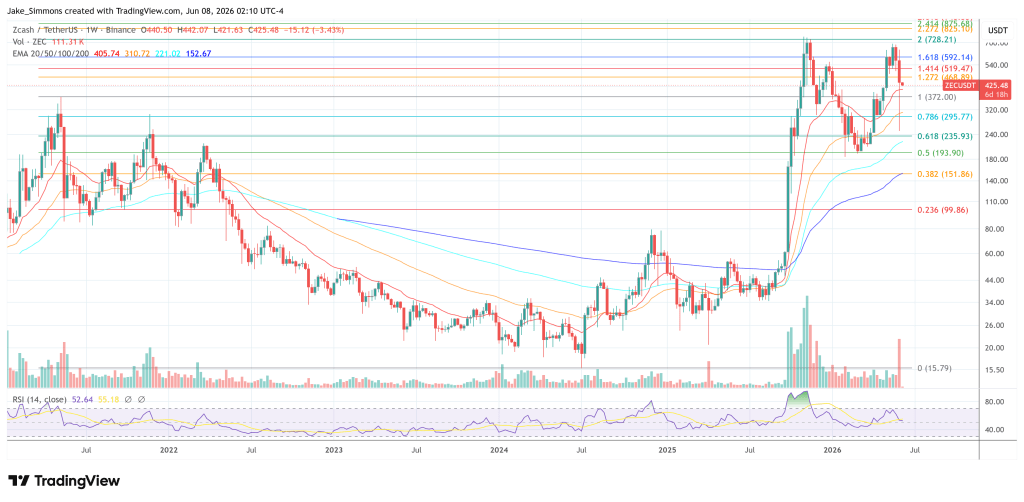
Featured picture created with DALL.E, chart from TradingView.com

Editorial Course of for bitcoinist is centered on delivering completely researched, correct, and unbiased content material. We uphold strict sourcing requirements, and every web page undergoes diligent assessment by our group of prime expertise specialists and seasoned editors. This course of ensures the integrity, relevance, and worth of our content material for our readers.


