

Justin Sun posted his phrases on X Monday evening – “the most decentralized blockchain in the world is Tron” – and the timing was not unintentional. Hours earlier, Arbitrum’s Safety Council had used emergency powers to freeze 30,766 ETH, roughly $71 million, stolen from Kelp DAO by what LayerZero has since attributed to North Korea’s Lazarus Group. Sun was not congratulating Arbitrum for stopping a hacker. He was pointing on the freeze as proof of centralization.
That’s the floor story. The deeper story is what it reveals concerning the combat Sun is definitely selecting – and whether or not TRON’s personal document holds as much as the usual he’s setting.
Okay. I'm formally saying: essentially the most decentralized blockchain on the earth is Tron.
— H.E. Justin Sun
(@justinsuntron) April 21, 2026
DISCOVER: The Subsequent 1000x Crypto Gem Earlier than It Lists on Binance
What the Arbitrum Freeze Really Reveals About Justin Sun TRON’s Technique
The Kelp DAO hack was genuinely ugly. On April 18, a hacker – now linked to Lazarus Group – exploited a bridge Kelp makes use of to maneuver its rsETH token between blockchains. Consider that bridge like a warehouse holding gold bars, whereas paper certificates flow into throughout totally different cities saying “good for one gold bar.” The hacker tricked the warehouse into handing out actual gold with out canceling the certificates. All of a sudden, billions in paper claims existed with no backing.
The hacker then walked that stolen rsETH over to Aave, the most important DeFi lending platform, and used it as collateral to borrow round $266 million in actual ETH. Aave was left holding nugatory receipts. The mixed Lazarus Group haul throughout this hack and a $285 million Drift Protocol exploit on April 1 totals $575 million stolen in 18 days.
Arbitrum’s Safety Council – a small group of signers with emergency powers constructed into the community – moved quick. At 11:26 p.m. ET on April 20, they froze the hacker’s pockets with regulation enforcement enter. For Arbitrum, this was the primary high-profile use of these powers. For Sun, it was a present.
I'm a member of the Safety Council & I can inform you we didn’t make this choice frivolously, there have been numerous hours of debates, technical, sensible, moral and political.
However all it takes for evil to triumph is for good males to do nothing, so at this time, we determined to do…
— Griff Inexperienced – griff.eth (@griffgreen) April 21, 2026
The Layer 2 vs Layer 1 debate has at all times had a centralization undercurrent. Layer 2 networks like Arbitrum sit on high of Ethereum, making transactions quicker and cheaper – however their safety structure sometimes includes sequencers and governance councils that may, in excessive instances, intervene. Sun’s argument is that TRON, as a Layer 1, avoids this. The mechanical level isn’t unsuitable. The Safety Council did freeze a pockets. That may be a type of centralized energy, even when used to cease a North Korean hacker.
However Sun is making this argument from a really uncomfortable place. In September 2025, Trump-backed World Liberty Monetary froze 545 million of Sun’s personal WLFI tokens, price round $100 million on the time. Sun publicly argued that freeze violated blockchain’s core ideas. Now he’s declaring TRON the world’s most decentralized chain on the precise evening a unique platform did the identical factor – to a suspected felony, with regulation enforcement concerned. The 2 conditions aren’t morally equal. However the mechanical critique Sun is leveling at Arbitrum utilized to his personal state of affairs too. And his community has fewer structural checks than the one he’s implicitly criticizing.
TRON vs. Arbitrum: What the Numbers Really Say
Put aside the rhetoric for a second and take a look at the information. TRON runs on Delegated Proof-of-Stake with 27 elected validators. Ethereum has over a million validators. Solana has over 1,000.
Fewer validators typically means fewer unbiased checks on the community – which is the alternative of what “most decentralized” implies. Analysis outlet Protos printed evaluation in March exhibiting that one individual owns greater than half of all TRX tokens in existence. That single information level makes the decentralization declare genuinely exhausting to defend on its face.
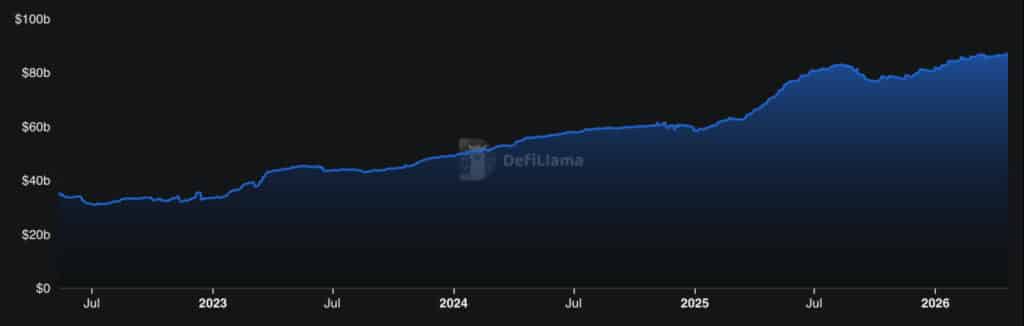
The place TRON does have a professional declare is in stablecoin dominance. The community hosts over $85 billion in TRC-20 USDT – practically 47% of worldwide USDT provide. It processes these transfers at $0.0003 common charges with 2,000 TPS. For customers sending USDT throughout borders, TRON is the default rail exactly as a result of it’s low-cost and quick. That’s the actual asset Sun is defending right here, not some summary decentralization precept.
Arbitrum and different Layer 2s have been aggressively capturing DeFi liquidity that used to sit down on Layer 1 networks. If stablecoin flows – significantly USDT – begin migrating towards Ethereum’s L2 ecosystem, TRON’s aggressive moat shrinks. Sun’s decentralization framing is, at its core, a retention argument dressed up as a philosophical one.
DISCOVER: Finest Meme Coin ICOs to Spend money on 2026
Comply with 99Bitcoins on X, YouTube, and Telegram for extra crypto information and evaluation.
The submit TRON vs. Arbitrum: Why Justin Sun Is Betting Big on a ‘Decentralized’ 2026 appeared first on 99Bitcoins.


