

Charles Hoskinson pushed again towards criticism that Cardano prioritized governance over scaling, arguing that the community’s present roadmap displays years of analysis relatively than a delayed pivot. The dispute comes as Enter Output’s newest treasury proposals put Leios, Peras, layer-2 infrastructure and developer tooling again on the middle of Cardano’s 2026 technical agenda.
In a publish on X, the Cardano founder mentioned he was “getting insanely tired” of what he referred to as a “false narrative” that scaling had been deserted in favor of governance. Hoskinson argued that scaling work had been steady since earlier than Shelley, spanning layer-2 designs, the eUTXO accounting mannequin, zero-knowledge analysis, partnerchains and, finally, Leios.
“It was an enormously challenging problem that we relentlessly attacked from many different angles including L2 innovations, a brand new accounting model- eutxo- zero knowledge ideas, partnerchains, and capstoning with Leios,” Hoskinson wrote. “Many of these ideas required deep r&d and original publications. This cannot be made faster by throwing more people at it. It’s research.”
Cardano Scaling Debate Heats Up
His feedback land at a delicate second for Cardano governance. Enter Output has submitted 9 treasury proposals for group assessment, describing them as tied to Cardano’s 2030 imaginative and prescient and targeted on scalability and decentralization. IO says the 2026 funding request totals $46.8 million, down from $97.5 million final 12 months, and is meant to assist ship key roadmap elements whereas shifting extra growth capability right into a broader contributor ecosystem.
That construction is a part of the stress. In a separate alternate, Hoskinson warned towards a fragmented voting consequence after group members debated whether or not the IO proposals must be handled as a coordinated bundle or as separate funding objects. Responding to issues that DReps may approve solely a subset of the proposals, he wrote: “Sadly, this is the end result of a piecemeal roadmap. It’s an iPhone by committee, with people deciding whether they prefer the fingerprint sensor to wireless charging. You end up with a bizarre, useless product.”
The core of Hoskinson’s argument is that Cardano’s scaling path couldn’t be separated cleanly from its governance path. Voltaire, in his view, was not a detour from throughput work however a prerequisite for deploying main upgrades in a system the place parameters, consumer range and treasury spending now require group legitimacy.
“No one was pulled from scaling research and development,” he wrote. “There were dozens of scientists and engineers brainstorming and prototyping for years. A semi-centralized and not secure halfway house could have been implemented that crashed all the time like other blockchains. Or we could do it right like we’ve always done things with the Cardano ecosystem. We chose the latter.”
Leios sits on the middle of that protection. IO’s treasury overview describes the consensus proposal as the most important technical initiative within the present portfolio and says it’s designed to ship sustainable throughput capability on the protocol stage. The identical overview says a Leios testnet is anticipated quickly, with mainnet focused by the tip of 2026, alongside a broader supply mannequin involving Intersect, Tweag and TxPipe.
Hoskinson introduced that because the payoff from Cardano’s slower, research-heavy method. “We now have a full design for Leios, Peras, and a great L2 strategy. They are elegant and future proof. We now have the best scaling strategy in the entire cryptocurrency space. That’s what the time bought us.”
The layer-2 aspect of the roadmap can be a part of the argument. IO’s proposal bundle contains manufacturing hardening for Hydra, a deliberate Midgard mainnet launch, and shared L2-agnostic primitives meant to assist present and future Cardano scaling techniques. The overview frames Hydra and Midgard as complementary relatively than competing designs, with Hydra focusing on known-party, high-frequency environments and Midgard geared toward open, permissionless purposes.
Hoskinson additionally used Bitcoin’s post-quantum debate as a distinction, arguing that Cardano’s governance system offers it a path to resolve contentious technical points with out splitting authority between casual factions. He claimed Bitcoin’s debate over whether or not to maneuver or depart susceptible cash uncovered is “the single greatest endorsement of the value of governance,” including that Cardano would “sidestep this issue thanks to governance.”
At press time, ADA traded at $0.2528.
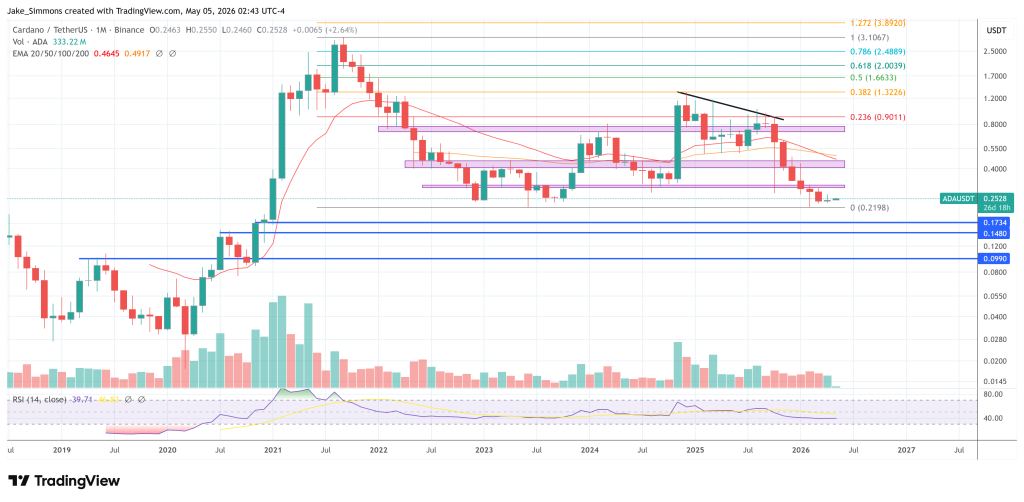
Featured picture created with DALL.E, chart from TradingView.com

Editorial Course of for bitcoinist is centered on delivering completely researched, correct, and unbiased content material. We uphold strict sourcing requirements, and every web page undergoes diligent assessment by our workforce of high expertise consultants and seasoned editors. This course of ensures the integrity, relevance, and worth of our content material for our readers.


