

Helius Labs CEO Mert Mumtaz has warned that crypto is coming into a brand new safety period through which AI, formal verification and better software program requirements may separate severe infrastructure groups from fragile protocols. In a extensively considered publish on X, he argued that crypto is “about to enter the space age,” with immutable monetary code more and more demanding the rigor of aerospace, chip manufacturing and different failure-intolerant industries.
Mumtaz’s central argument is that the majority software program has traditionally tolerated a degree of sloppiness that crypto can now not afford. In typical web companies, a bug might trigger downtime, misplaced income or an embarrassing outage, however centralized operators can often intervene, patch the system, roll again modifications or compensate customers. Crypto, he wrote, is structurally totally different as a result of its core promise will depend on irreversible execution in adversarial environments.
“Immutable financial code is akin to a spaceship leaving Earth that you have no further control over. It must work, or there will be catastrophe,” Mumtaz mentioned. “This crisis has come up before. In the late 1960s, a NATO conference declared a ‘software crisis,’ as the software industry was getting increasingly sloppy and no one could really reason about these systems at scale.”
Crypto Should Attain Spaceflight-Degree Safety
He linked that earlier software program disaster to the mental roots of formal verification, citing Edsger Dijkstra and the long-standing argument that testing can present the presence of bugs, however not their absence. For programs the place correctness issues, Mumtaz mentioned, software program needs to be handled much less like an iterative client product and extra like a mathematical object that may be reasoned about and confirmed.
That framing is very related to crypto as a result of blockchain programs deal with billions of {dollars} in belongings by code that’s public, immutable and continually probed by attackers. Mumtaz argued that the trade has usually adopted the danger profile of aviation or spaceflight whereas retaining the event tradition of net purposes. In his phrases, crypto falls into the class of low-margin-of-error software program industries, but “most of the industry has been built using the sloppy standards of the former, human-intervenable systems.”
The Helius Labs CEO additionally took goal at what he described because the “facade of decentralization” that has softened the perceived urgency of the issue. Admin keys, managed validator units, social coordination and emergency interventions, he argued, have created a short-term sense of consolation. However these mechanisms additionally blur the excellence between genuinely autonomous programs and programs that may nonetheless be rescued by human operators when one thing breaks.
Mumtaz expects that distinction to change into more durable to disregard as AI improves. Moderately than viewing AI solely as a risk vector, he framed it as a drive that can make rigorous software program practices extra accessible. Specification writing, proof help, symbolic reasoning, fuzzing, audits, invariant checking and formal verification workflows, he mentioned, may change into dramatically simpler to make use of at scale.
“The silver lining is that AI will greatly streamline the process of formal verification and making programs more rigorous. What was once extremely manual and expensive will now become tractable at scale: specification writing, proof assistance, symbolic reasoning, fuzzing, audits, invariant checking, and formal verification workflows will all get dramatically more accessible,” he wrote. “This set of circumstances will lead to crypto reaching its ultimate potential, but I suspect only through trial by fire.”
That “trial by fire” is the crux of his warning. Mumtaz mentioned an “aggressive natural selection mechanism” has already begun and will proceed for a number of years. Robust groups, in his view, will emerge with extra resilient programs, whereas weaker architectures will fail beneath greater safety expectations and more and more succesful adversarial tooling.
He was cautious to not body these failures purely as malicious or negligent. “The serious teams will emerge stronger than ever, while straw houses will collapse,” Mumtaz wrote, including that the latter shouldn’t essentially be learn as an insult as a result of these programs are genuinely laborious to construct.
The broader implication is that crypto’s subsequent aggressive cycle might not be outlined solely by throughput, liquidity incentives or distribution, however by demonstrable correctness. Mumtaz’s finish state is an trade the place safety, rigor and privateness change into first-class issues once more, permitting crypto to change into “demonstrably safer, more robust, and more Lindy than any centralized financial system.” His closing line was blunt: “I am long math and I am long crypto.”
The timing of Mert’s publish is notable as a result of it got here simply after Anthropic’s June 9 launch of Claude Fable 5 and Claude Mythos 5, a rollout that underscored how rapidly AI is shifting into offensive and defensive safety analysis. Anthropic mentioned Fable 5 is its most succesful typically obtainable mannequin, however added safeguards round cybersecurity queries as a result of the identical capabilities could possibly be misused; Mythos 5, the less-restricted model, is being restricted at first to chose cyberdefenders and infrastructure suppliers by Undertaking Glasswing in collaboration with the US authorities.
For DeFi, that’s the uncomfortable a part of the story. If fashions can more and more cause by giant codebases, determine delicate logic flaws and assist flip vulnerabilities into working exploits, then public good contracts change into a pure goal for AI-assisted bug searching. Mumtaz’ “straw houses” warning is subsequently not summary: AI might sharply compress the time it takes each auditors and attackers to search out the subsequent damaged invariant, unsafe assumption or exploitable edge case in crypto’s monetary code.
At press time, the overall crypto market cap stood at $2.12 trillion.
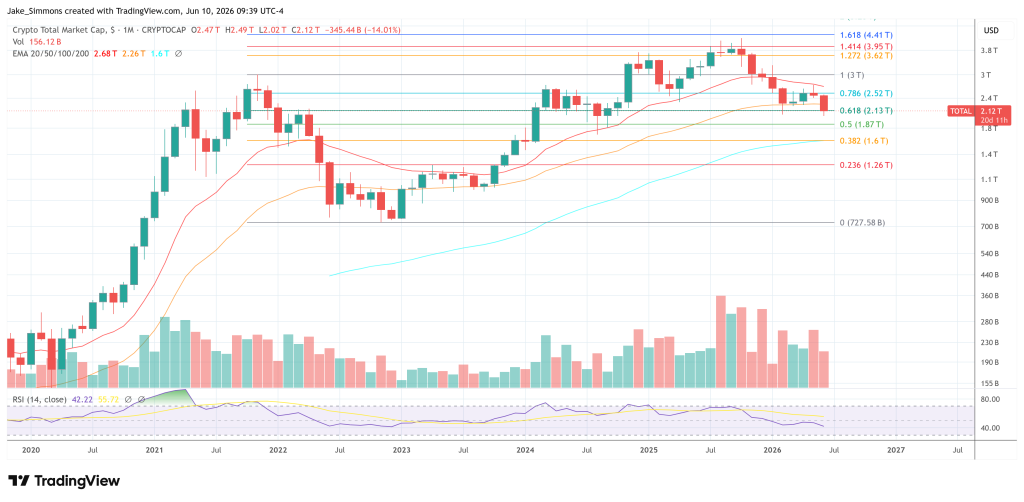
Featured picture created with DALL.E, chart from TradingView.com

Editorial Course of for bitcoinist is centered on delivering totally researched, correct, and unbiased content material. We uphold strict sourcing requirements, and every web page undergoes diligent evaluation by our workforce of prime expertise consultants and seasoned editors. This course of ensures the integrity, relevance, and worth of our content material for our readers.


