

Solana co-founder Anatoly Yakovenko has referred to as for an additional try to speed up SOL disinflation, after a brand new GitHub dialogue proposed enhancing Solana’s tokenomics by way of a resource-based base charge that may be absolutely burned. The talk places SOL issuance, charge burn mechanics and validator economics again on the heart of Solana governance after final yr’s failed SIMD-0228 vote.
The trade started with a put up from pseudonymous Solana researcher Dr Cavey phd, who wrote, “MSTHDA(FTFT): make SOL $300 again (for the first time). discuss.” Helius CEO Mert Mumtaz replied, “do it,” whereas Yakovenko added a easy “+1.” Vibhu Norby, Solana Basis Chief Product Officer and Interim CMO, responded with an eyes emoji.
SIMD-0547 Places Solana Burn Mechanics Again In Focus
The dialogue was opened with a Might 30 GitHub put up by dr cavey phd beneath the title “Improving SOL tokenomics via a resource-based base fee.” The SIMD-0457 argues that Solana’s present burn is simply too small to provide SOL significant publicity to community exercise. “Presently, the SOL burn on the network is incredibly tiny and insignificant,” the put up stated. “At a throughput of 3000 TPS, or 259M Tx/day, the 2500 base fee burn results in 648 SOL burned per day. If you isolate this to only nonvotes, this is even smaller.”
The writer rejected a easy across-the-board base charge enhance, arguing it might hit the flawed elements of the community. Retail customers and searchers typically pay precedence charges far above the bottom signature charge, whereas validators and market makers ship excessive transaction volumes the place the bottom charge is a bigger share of price. “So, increasing the base fee outright and uniformly would threaten decentralization,” the put up stated, citing stress on validator profitability, and would additionally threaten Solana’s spot market construction by growing market maker mounted prices.
As a substitute, the proposal requires a resource-based base charge that may be solely burned. Every Solana transaction already has a price profile based mostly on compute items, information loaded, write locks and different variables. The recommended mechanism would cost and burn 0.1 lamport per price unit requested, with the writer saying the determine was chosen to keep away from materially growing prices for market makers, whose oracle updates usually request fewer than 2,500 price items.
The proposal’s examples present sharply completely different results relying on transaction sort. A Shekel-to-SOL swap through OKX would rise from a 5,000 base charge plus 130,980 precedence charge to incorporate a further 82,432 new burned base charge, a 60% enhance. A SOL-to-TRANSCEND transaction through Pump with no precedence charge would see prices rise 639%. A USDC-to-99% transaction through DFlow with a big precedence charge would rise solely 2%, whereas a Zerofi oracle replace would rise 3%.
The draft estimated that, assuming most blocks request 50 million to 300 million whole price items, the mechanism might burn roughly 1,080 to six,480 SOL per day, with the writer’s “hunch” nearer to 2,160 SOL per day. That might come on high of the present roughly 648 SOL every day base-fee burn, however nonetheless sit effectively under estimated inflation of about 60,000 SOL per day.
Commenters instantly centered on whether or not the proposed burn can be giant sufficient to matter. One reply argued the mixture estimate wanted tighter empirical help, whereas one other offered latest requested compute-unit information suggesting present utilization might put the burn within the 1,500 to 1,800 SOL per day vary. One other commenter warned that, with Solana inflation nonetheless round 3.8%, the mechanism would deflate solely about 0.1% at present requested items and would wish roughly 10 occasions present demand to strategy 1% deflation, assuming charge demand didn’t taper.
SIMD-0411 Revives Solana’s Failed Disinflation Debate
Yakovenko’s personal response got here after the dialogue moved to X. Dr. Cavey later shared a meme saying, “I want you to improve the monetary policy of SOL,” quoting dealer Ansem’s view that SOL may lead once more with extra breakout apps and improved financial coverage. Yakovenko replied: “Make another simd to double the disinflation rate.” Helius CEO Mert Mumtaz answered that the ecosystem “already” has one, pointing to SIMD-0411.
SIMD-0411 proposes growing Solana’s disinflation charge from 15% to 30%, accelerating the decline in SOL issuance whereas leaving the terminal inflation charge at 1.5%. Its authors mannequin the change as bringing Solana to terminal inflation in 3.1 years, round early 2029, quite than 6.2 years, round early 2032. They estimate a discount of twenty-two.3 million SOL in emissions over six years, or about 3.2% decrease provide than beneath the present path.
The proposal is deliberately less complicated than SIMD-0228, which failed in March 2025. SIMD-0228 sought to introduce a market-based emissions mannequin tied to staking participation, nevertheless it didn’t clear Solana’s two-thirds approval threshold. It acquired roughly 61.6% help, in need of the 66.67% required, regardless of participation from about 74% of staked SOL throughout 910 validators.
The failure was not because of indifference. It mirrored a break up over who bears the price of decrease emissions. Supporters stated Solana was overpaying for safety and diluting SOL holders. Opponents, particularly smaller validators, warned {that a} sharp lower to staking rewards might weaken validator economics and stress decentralization. That historical past now frames the brand new debate: Solana’s subsequent tokenomics push might have to mix decrease issuance or greater burn with a reputable reply for validator sustainability.
At press time, SOL traded at $81.41.
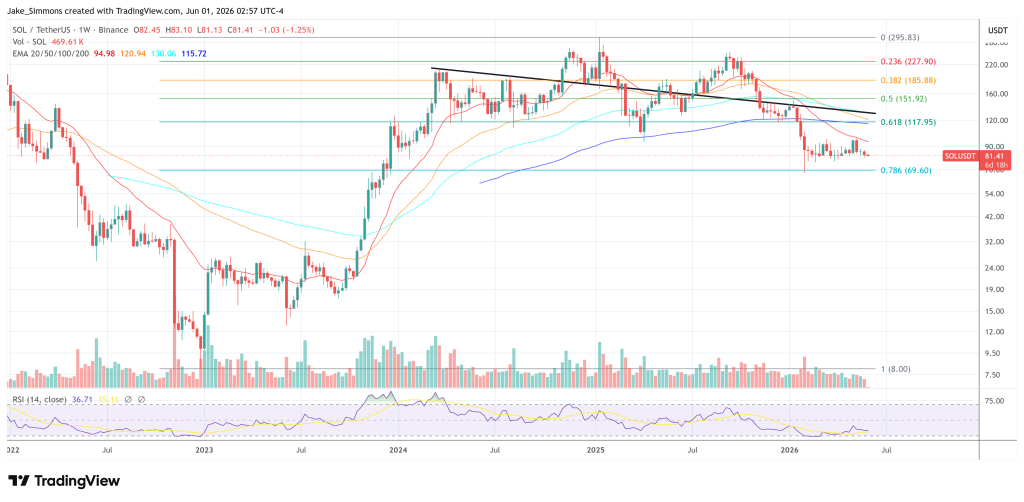
Featured picture created with DALL.E, chart from TradingView.com

Editorial Course of for bitcoinist is centered on delivering completely researched, correct, and unbiased content material. We uphold strict sourcing requirements, and every web page undergoes diligent overview by our group of high know-how specialists and seasoned editors. This course of ensures the integrity, relevance, and worth of our content material for our readers.


