

Tether froze $344M in USDT throughout two blockchain addresses on April 23, 2026, performing on data from the Workplace of International Property Management and U.S. regulation enforcement in a coordinated motion that concurrently added two Central Financial institution of Iran-linked crypto addresses to OFAC’s sanctions listing, marking the most recent development within the Iran stablecoin drama.
Blockchain analytics agency Chainalysis revealed its evaluation 4 days later, mapping a layered monetary pipeline working from Iranian oil revenues via brokers, middleman wallets, DeFi bridges, and again into accounts affiliated with the Islamic Revolutionary Guard Corps.
OFFICIAL: Treasury Secretary Scott Bessent FREEZES $344 MILLION in Iranian crypto
"We will follow the money that Tehran is desperately attempting to move outside of the country and target all financial lifelines tied to the regime." pic.twitter.com/1zBfrk5a0H
— Altcoin Every day (@AltcoinDaily) April 24, 2026
The element most headlines are lacking is what this motion reveals a few perception hundreds of thousands of stablecoin holders carry quietly: that USDT works like digital money that nobody can contact. This story is direct proof that it doesn’t – and understanding why issues whether or not you’re in Tehran or Toronto.
USDT’s whole market cap at present sits above $144Bn, making it by far the most important stablecoin in circulation and the asset of alternative for each official customers and, as this case exhibits, state-level sanctions evaders.
What the Chainalysis Iran USDT Hint Really Reveals
OFAC just lately added 2 crypto addresses to its Central Financial institution of Iran (CBI) designation. Concurrently, Tether froze $344 million in USDT tied to those wallets, disrupting funds linked to illicit oil gross sales & the IRGC. Learn our on-chain evaluation:
— Chainalysis (@chainalysis) April 27, 2026
Tether, the issuer of USDT, has a grasp key that permits it to freeze any pockets holding its tokens. When OFAC identifies a sanctioned tackle, Tether can blacklist it, locking the funds in place and stopping transfers. The $344M wasn’t seized; it was frozen, like funds in a blocked account.
Chainalysis traced the infrastructure round these wallets earlier than the freeze. Funds flowed from brokers changing Iranian fiat into stablecoins, handed via middleman wallets, crossed DeFi bridges to obscure the path, and returned to Iranian crypto exchanges and IRGC-affiliated accounts.
They famous that Central Financial institution of Iran stablecoin funds had been laundered via varied protocols earlier than being re-entered into the Iranian crypto ecosystem. Analyst Alireza Derakhshan was linked to coordinating over $100M in crypto tied to Iranian oil gross sales.
EXCLUSIVE: 99Bitcoin’s Readers – Earn $10 USDC When You Signal Up for Binance
Why This Enforcement Motion Is Extra Difficult Than It Seems to be
The optimistic perspective is that the current freeze exhibits stablecoin issuers performing as efficient compliance gatekeepers. Tether has frozen belongings price $4.4Bn, together with $2.1Bn on the request of the U.S. authorities, indicating ongoing enforcement efforts.
Conversely, skeptics spotlight Iran’s refined multi-layered routing system, which complicates tracing, suggesting {that a} important quantity might have moved undetected earlier than this motion. In 2025, illicit crypto addresses acquired over $154Bn globally, with stablecoins accounting for a lot of that.
Moreover, Iran’s transition from bitcoin to stablecoins was pushed by the necessity for liquidity and stability, with findings exhibiting the Central Financial institution of Iran accumulating $507M in USDT to assist the rial and commerce underneath sanctions. This incident underscores the centralized management of stablecoin issuers that has been downplayed of their advertising and marketing.
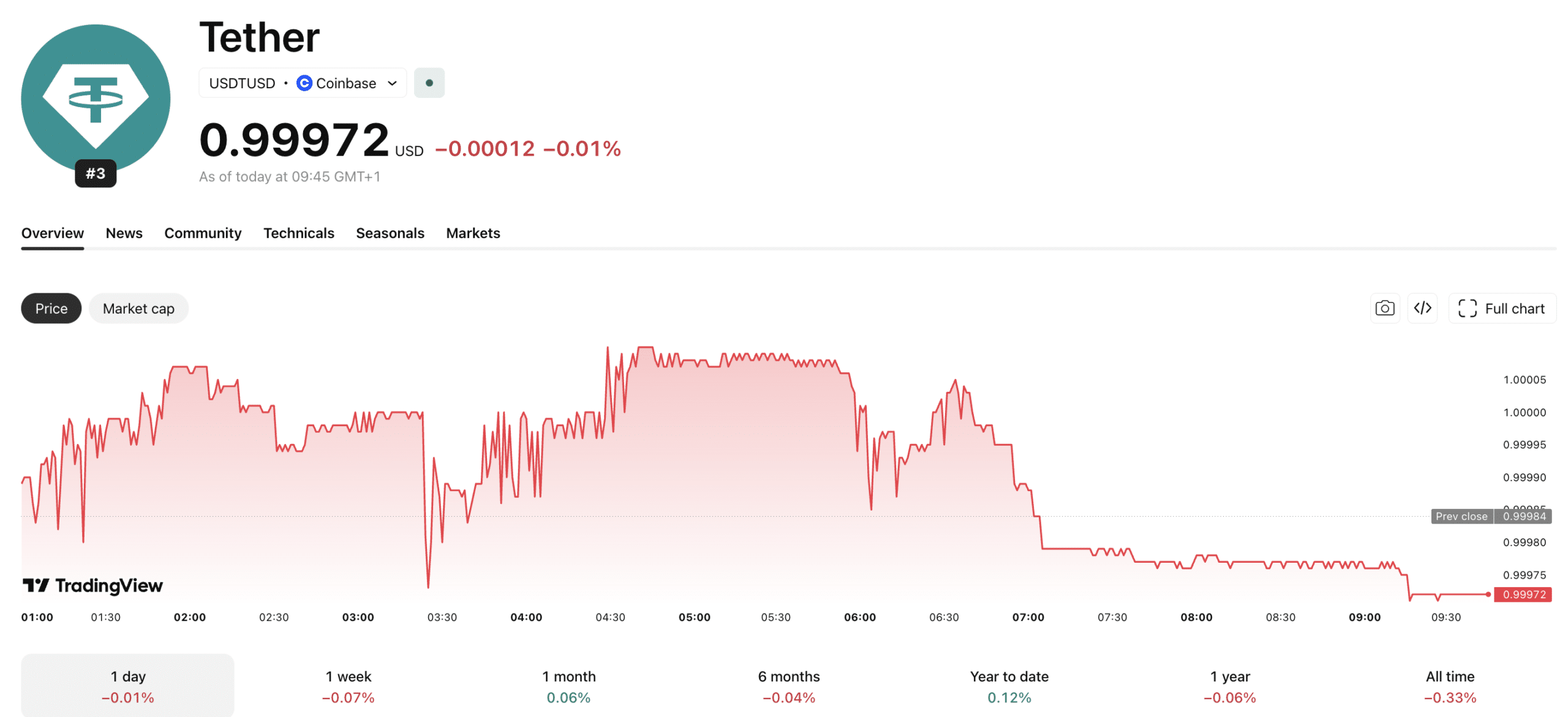
(SOURCE: TradingView)
What the Iran Stablecoin USDT Freeze Means for Your Stablecoin Holdings
For those who maintain USDT and aren’t related to sanctioned entities, the danger to your funds is low. Tether’s freezes are focused primarily based on formal sanctions designations, not random audits.
Nonetheless, USDT will not be censorship-resistant like Bitcoin; Tether can freeze wallets on request, making it a software for monetary enforcement.
Retail customers face dangers via intermediaries, as some exchanges might have unknowingly participated in sanctioned actions. If an alternate or pockets supplier is caught in enforcement actions, entry to your funds could possibly be disrupted, even with out wrongdoing in your half.
Preserve an eye fixed out for OFAC increasing designations to incorporate extra Iranian brokers and intermediaries, as the following spherical will present the extent of the community concerned.
EXPLORE: Finest Crypto Presales With Staking Rewards
Comply with 99Bitcoins on X, YouTube, and Telegram for extra crypto information and evaluation.
The put up Chainalysis Traces Iran Stablecoin Network After $344M USDT Freeze appeared first on 99Bitcoins.


